
GPU Cluster Overview: Performance Metrics that Matter
Are you getting the most out of your expensive hardware? Or is it just sitting idle while costs keep going up? In high-demand places, knowing how your systems are doing is not just a tech thing. It’s a financial must.
Keeping an eye on GPU utilization helps you make smart choices that save money. By setting a clear goal for your ai porn gpu clusters, you can spot problems before they slow you down.
Good management of gpu clusters means your computing power matches your goals. By watching GPU utilization regularly, you turn numbers into useful tips that boost your whole team’s work.
Key Takeaways
- Watching how your hardware does is key to getting your money’s worth.
- Having a performance standard helps find hidden system problems.
- Smart choices based on data lead to better use of resources in tough spots.
- Regular checks keep your setup running smoothly and fast.
- Improving your computing setup begins with looking at the right numbers.
Assessing Your Computational Requirements
Building a high-performance cluster begins with knowing your needs. Before buying hardware, define your AI tasks’ intensity. This avoids over-provisioning and performance gaps. The right size ensures your infrastructure meets your goals.
Defining Your Workload Intensity
Your workload intensity determines the hardware needed. Training large language models needs more power than simple tasks. Evaluate your concurrent request volume to decide on throughput or low latency.
Think about your data processing pipelines. If models need frequent updates, your system must handle rapid data ingestion. Scalability is crucial for future growth.
Estimating VRAM and Compute Needs
Accurate hardware estimation prevents OOM errors in large-scale training. Calculate memory utilization based on model parameters and batch sizes. Precision in these calculations helps allocate resources well.
Monitoring memory helps decide when to add more GPUs. Balancing compute power with VRAM ensures smooth processes. Use the table below to match your project with hardware expectations.
| Workload Type | VRAM Requirement | Compute Priority |
|---|---|---|
| Small Inference | Low (8GB – 16GB) | Latency |
| Medium Training | Moderate (24GB – 40GB) | Throughput |
| Large Scale LLM | High (80GB+) | Parallelism |
Selecting Hardware for AI Porn GPU Clusters
Choosing the right hardware for ai porn gpu clusters is key. You need to balance power and physical limits. Look at how different architectures handle tough training tasks to get the best results. Follow these hardware tips to pick the right computing parts.
Evaluating NVIDIA A100 and H100 Performance
The NVIDIA A100 is a top choice for many, offering solid performance for various tasks. But, the H100 brings a big boost in performance, especially for big models. Go for the H100 if you need faster work and more memory.
Think about what your models need in terms of precision. The A100 is great for most tasks, but the H100 has special engines for deep learning. Your choice depends on whether you want to save money or go for speed.
Balancing GPU Density with Cooling Constraints
High-density ai porn gpu clusters can get very hot. This heat can damage your hardware. It’s crucial to manage airflow well to keep your system running smoothly.
Think about using liquid cooling for tight spaces. It lets you pack more GPUs without overheating. Make sure your setup can handle the power and heat before you buy.
Choosing Between PCIe and NVLink Interconnects
The way you connect your GPUs affects how fast data moves. NVLink offers a big speed boost, letting GPUs talk directly. It’s best for complex models that need fast updates.
If you’re on a tight budget, PCIe is a good option for smaller setups. It might be a bit slower than NVLink, but it works well for many tasks. Use these hardware tips to match your interconnect choice with your needs and goals.
Designing the Network Architecture for High Throughput
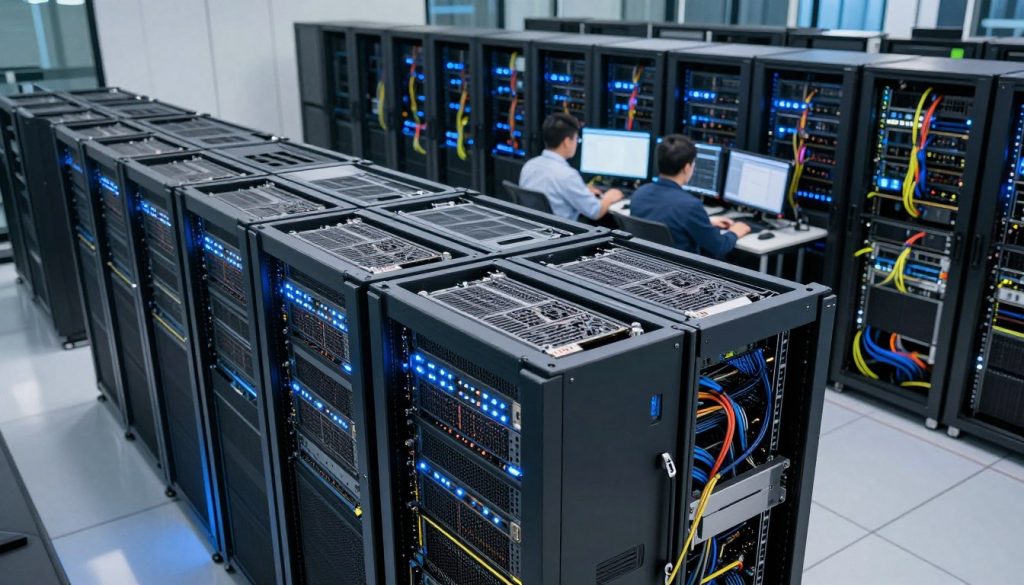
Your network is like the brain of your computing setup. When you add more gpu clusters to handle big tasks, how fast they talk to each other matters a lot. A bad network design can slow everything down, wasting a lot of work.
Implementing InfiniBand for Low Latency
For today’s AI needs, regular Ethernet isn’t enough. InfiniBand gives you the speed and low delay needed for smooth communication between nodes. This is key for latency reduction in big training jobs.
Using this tech lets your hardware talk directly, without going through the usual OS steps. This direct path is crucial for your GPUs to work together fast. Reliability and speed make it the top choice for big setups.
Optimizing Data Transfer Between Nodes
Fast data movement needs Remote Direct Memory Access (RDMA) protocols. By moving data tasks from the CPU to the network card, you boost speed. This keeps your GPUs busy, avoiding idle time.
Designing for latency reduction helps keep your system balanced. Choose low-hop topologies to keep nodes close. This reduces wait times, keeping your training smooth.
Reducing Network Congestion in Multi-GPU Setups
Too many nodes can cause network congestion. Use traffic shaping and non-blocking switches to manage this. Proper management stops bottlenecks before they slow you down.
Here’s a comparison of network techs to see how they affect performance:
| Feature | Standard Ethernet | InfiniBand |
|---|---|---|
| Latency | High (Microseconds) | Ultra-Low (Nanoseconds) |
| Throughput | Variable | Consistent/High |
| CPU Overhead | Significant | Minimal (RDMA) |
| Scalability | Moderate | Excellent |
Choosing the right interconnects and managing traffic well makes a strong network. Consistency in design is crucial for getting the most from your hardware.
Configuring Software Stacks and Drivers
A high-performance cluster needs a solid software base to link hardware to AI apps. Without it, your expensive hardware can’t talk to your models well. Standardization helps keep your cluster stable and reliable over time.
Installing CUDA and cuDNN Environments
Your software stack starts with the right CUDA environments installed. Make sure your drivers match the CUDA toolkit and cuDNN libraries your deep learning needs. Using the NVIDIA GPU Operator helps keep drivers updated across all nodes.
This automation keeps your cluster consistent. It stops version mismatches that cause errors in big training jobs. Always check your kernel modules are up-to-date with NVIDIA drivers before going live.
Managing Containerization with Docker and Kubernetes
Docker containers make AI infrastructure portable. They ensure your code works the same everywhere, from a single machine to a big cluster. This makes managing dependencies easier and speeds up scaling tasks.
Kubernetes orchestration manages these containers at scale. It automates deploying, scaling, and managing apps across your nodes. It also handles resources, so your jobs get the power they need without you having to do it manually.
Optimizing Frameworks for Distributed Training
With a solid base, focus on making your frameworks better for distributed training. Use libraries like NCCL for fast GPU communication. Tweak these frameworks to cut latency and boost your training pipeline’s speed.
| Component | Primary Function | Optimization Goal |
|---|---|---|
| NVIDIA Drivers | Hardware Interface | Maximum Stability |
| Docker | Environment Isolation | Deployment Speed |
| Kubernetes | Cluster Management | Resource Efficiency |
| NCCL | Inter-GPU Communication | Reduced Latency |
By sticking to these standards, you build a strong environment for tough AI tasks. Consistency in your software stack is key to lasting cluster performance and success.
Measuring Render Speed and Throughput Metrics
Checking how well your high-performance computing setup works means looking closely at render speed and throughput. Keeping an eye on these numbers helps make sure your hardware is doing its job well for your projects.
Establishing Baseline Performance Benchmarks
To improve your cluster, you first need to know what’s normal. This means running tests on a known task to get initial performance numbers.
These benchmarks are key for comparing later. If performance drops, you can quickly see if it’s a problem by comparing current numbers to your baseline.
Analyzing Frames Per Second and Latency
For tasks that need to show things in real-time, like video, frames per second (FPS) is key. High FPS means your cluster is working well without big slowdowns.
But, don’t forget to watch latency too. High latency can mean network problems or slow communication, which can slow down render speed.
Tracking GPU Utilization Rates Under Load
Watching GPU utilization shows how well your hardware is doing its job. You want to see high numbers, meaning your expensive processors are busy.
It’s also key to check memory utilization. If memory use is high but compute tasks are low, you might need to change your data setup or add more VRAM.
| Metric | Target Range | Impact Level |
|---|---|---|
| GPU Utilization | 85% – 95% | High |
| Memory Utilization | 70% – 80% | Medium |
| Frames Per Second | Stable Baseline | High |
| Network Latency | < 5ms | Critical |
Monitoring Thermal and Power Efficiency
Learning to manage thermal and power efficiency can extend your GPU’s life. Keeping your hardware in a stable environment is key. It’s not just about speed; it’s about protecting your investment.
By following these hardware tips, your cluster will stay reliable even when tasks get tough.
Implementing Real-Time Temperature Tracking
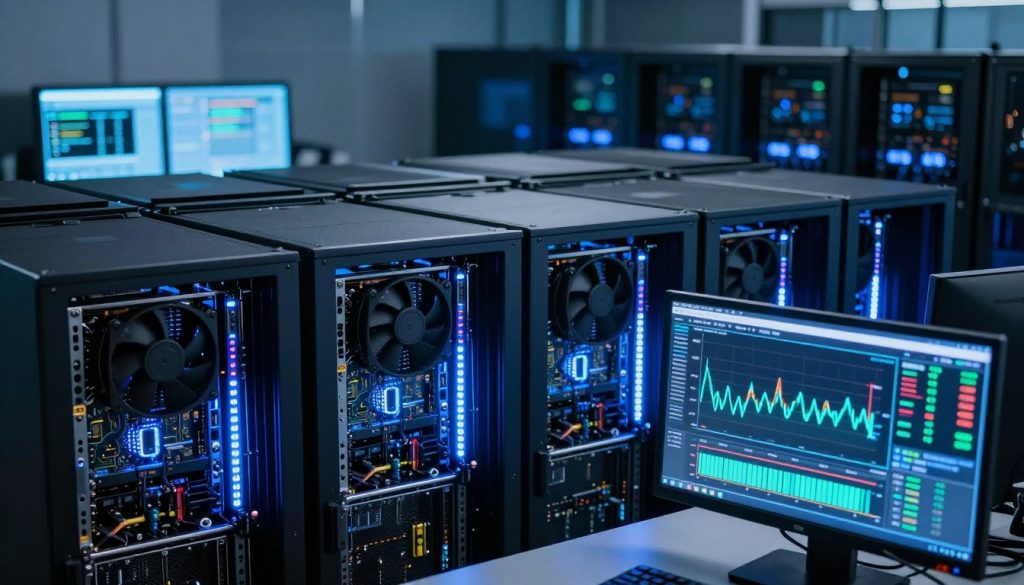
Modern GPUs have sensors to track their internal temperature. The edge sensor gives a general idea, but the hotspot sensor is more critical. It usually triggers safety measures.
Monitoring these values in real-time is essential. This way, you can see how your hardware is doing.
Specialized software lets you see these data points live. If the hotspot temperature gets too close to the limit, check your cooling. Catching issues early prevents bigger problems.
Managing Power Consumption and TDP Limits
High-performance clusters often run at their limits, affecting power consumption. Tools like NVIDIA-SMI let you set TDP limits. This balances power use with efficiency, avoiding power supply issues.
Setting these limits is a key hardware tip for a stable cluster. It keeps power use in check without losing too much performance. This makes your system more stable for demanding tasks.
Preventing Thermal Throttling During Peak Usage
When temperatures get too high, your hardware will slow down to protect itself. This is called thermal throttling. It lowers performance suddenly. You need to avoid this to keep your cluster running smoothly.
To prevent throttling, make sure your setup has good airflow. Also, make sure your fans kick in before it gets too hot. Cleaning dust and checking thermal paste can also help. This way, you keep your system running at its best.
Troubleshooting Bottlenecks in Your Cluster
When your high-performance computing tasks slow down, the culprit is often buried deep within your hardware configuration. Even the most advanced gpu clusters require constant vigilance to maintain optimal throughput. By learning to interpret hardware-level fault codes, you can significantly reduce downtime during production cycles.
Identifying CPU and Memory Constraints
Performance degradation often stems from CPU constraints that prevent your GPUs from receiving data fast enough. If your processors are pinned at 100% utilization while your graphics cards remain idle, you have a clear bottleneck. You should monitor system-wide memory usage to ensure that large datasets are not causing excessive swapping to disk.
Upgrading your system memory or optimizing your data pre-processing pipelines can often alleviate these issues. Always verify that your BIOS settings are configured for maximum performance rather than power saving. This simple step ensures that your processors can handle the heavy lifting required by modern AI workloads.
Resolving PCIe Bandwidth Limitations
Another common issue involves PCIe bandwidth limitations that restrict the speed of data transfers between your storage and the GPU. If you notice that your transfer rates are lower than the theoretical maximum, check your lane configuration. Ensure that all cards are seated in slots that support the full x16 bandwidth required for high-speed operations.
Sometimes, a simple firmware update for your motherboard or riser cables can resolve intermittent connectivity problems. You must also verify that your drivers are correctly reporting the link speed. If the system defaults to a lower generation, your overall cluster performance will suffer significantly.
Debugging Inter-Node Communication Errors
Large-scale gpu clusters rely heavily on stable inter-node communication to function as a single unit. Errors in your NVLink or InfiniBand fabric can lead to silent data corruption or massive latency spikes. You should use diagnostic tools to scan for link degradation and verify that all cables are securely connected.
If you encounter persistent communication failures, inspect your switch logs for packet loss or CRC errors. Addressing these physical layer issues early prevents the cascading failures that often plague complex distributed systems. Maintaining a clean and organized cabling environment is essential for long-term stability.
| Symptom | Potential Cause | Recommended Action |
|---|---|---|
| Low GPU Utilization | CPU constraints | Optimize data pipeline |
| Slow Data Transfer | PCIe bandwidth | Check slot configuration |
| Node Timeouts | Network fabric error | Inspect switch logs |
| System Instability | Thermal throttling | Clean cooling fans |
Scaling Your Infrastructure for Future Growth
To build a scalable environment, you need a smart plan for hardware and network design. You should think ahead to meet growing demands. This way, your systems can handle complex tasks without needing a full overhaul later.
Planning for Modular Cluster Expansion
Choosing a modular expansion strategy lets you grow your compute power step by step. Instead of buying huge systems, you can add smaller, standard units. This keeps costs down and lets you quickly adapt to new projects.
“The most successful clusters are those designed with the assumption that the hardware will change, but the architecture will remain robust.”
Here are some benefits of modular design:
- Less downtime during upgrades.
- Easier maintenance of each compute node.
- Better power distribution in the cluster.
Upgrading Interconnects for Higher Bandwidth
As you add more nodes, the network can slow down your render speed. Upgrading your interconnects helps data move fast between GPUs. Choosing high-speed fabric now prevents slowdowns as your cluster grows.
| Interconnect Type | Bandwidth Capacity | Latency Profile |
|---|---|---|
| Standard Ethernet | Low | High |
| InfiniBand HDR | High | Ultra-Low |
| NVLink Switch | Extreme | Minimal |
Integrating New GPU Architectures Seamlessly
Technology advances fast, and your cluster needs to be ready for new hardware. A good software stack lets you add new GPU architectures smoothly. Using containers helps keep environments separate and compatible with different hardware.
Keep your driver environment consistent for easy modular expansion. Preparing your software for future hardware keeps your investment valuable. This forward-thinking approach keeps your team productive and your infrastructure competitive.
Conclusion
Managing your GPU cluster is a continuous task. It needs a mix of knowing your hardware and using software well. Think of it as a living system that always needs your attention.
Keeping an eye on important metrics helps improve performance and avoid expensive failures. Watch the temperature and power use closely. This care keeps your NVIDIA gear and fast connections running smoothly.
Good clusters focus on being easy to watch and automate from the start. Using tools for real-time monitoring gives you an edge. This way, you reduce downtime and boost your work’s output.
Apply these tips to create a strong, efficient setup for your computing tasks. Your dedication to upkeep and planning will pay off. Begin improving your cluster management now to stay on top.
FAQ
Why is monitoring GPU utilization critical for my infrastructure?
Monitoring GPU utilization helps you see how well your ai porn gpu clusters work. It lets you know if your hardware is being used efficiently. This way, you can make smart choices about how to use your resources and catch problems early.
This is key to making your whole system run smoothly and fast.
How can I prevent OOM errors during large-scale AI training?
To avoid OOM errors, you need to know how much VRAM your model and requests need. Checking memory use helps make sure your gpu clusters fit your needs. This stops problems that happen when your hardware isn’t quite right for big AI tasks.
Should I choose the NVIDIA A100 or NVIDIA H100 for my cluster?
It depends on what you need and how much you can spend. The NVIDIA H100 is great for transformer models, but the A100 is good for many tasks and is cheaper. Think about your data center’s space and what kind of connections you need to balance power and cooling.
How does InfiniBand improve performance in distributed training?
InfiniBand makes nodes talk to each other fast and clear in gpu clusters. It cuts down on network problems and stops slow nodes from slowing down the whole job. This keeps your cluster running fast during big training tasks.
What is the benefit of using the NVIDIA GPU Operator in a Kubernetes environment?
The NVIDIA GPU Operator makes managing your system easier by keeping drivers and settings the same everywhere. It helps you avoid problems and makes it easier to grow your AI apps across many nodes.
How do I accurately measure the render speed and throughput of my cluster?
To check render speed and throughput, start with some benchmarks and look at frames per second under heavy loads. It’s important to know if your workloads are compute or memory bound. This shows if your hardware is doing its job well.
What thermal sensors should I monitor to prevent performance degradation?
Watch the edge, hotspot, and memory junction sensors for temperature. The hotspot sensor can slow down your render speed if it gets too hot. Keeping an eye on these and following TDP limits helps your hardware last longer.
How can I identify and resolve bottlenecks within my GPU clusters?
Look for CPU, PCIe, and NVLink issues to find bottlenecks. If your speed is off even when GPUs are busy, it might be communication problems. Knowing how to read fault codes helps fix these issues fast.
What is the best strategy for scaling my AI infrastructure?
For growth, plan to add to your cluster in small steps and upgrade your connections for more speed. Make sure new NVIDIA tech fits well with what you already have. This way, your system can handle more work without slowing down.