Zero Minutes: The Day You Didn’t Open the Generator at All (2026)
Quick verdict: Zero minutes is not a lost day. A full day without opening the generator costs nothing, teaches you what your habit actually looks like from the outside, and usually makes the next session better. If you open it every day out of reflex, one deliberate day off is the cheapest experiment you will ever run.
Contents:
- 1. What Zero Minutes Actually Means
- 2. The Day, Hour by Hour
- 3. What the Day Gives Back
- 4. The Urge to Peek
- 5. What You Notice Without a Screen
- 6. What It Costs
- 7. Honest Limitations
- 8. Who This Is For
- 9. Consent and Safety
- 10. Final Verdict
- 11. FAQ
1. What Zero Minutes Actually Means
Zero minutes is not a lost day; it is a day the generator never got to touch. It means you do not open the tool, you do not queue a render, you do not check a result, and you do not scroll the gallery to see what other people made. The day is not empty. It is full of everything else, and that is the point. Most creators never find out what a day without the generator feels like, because the generator is always one click away and the click is always easier than the question.
The habit is easy to miss because it looks like work. You open the generator in the morning to warm up, again at lunch to test one idea, and again at night because the day feels unfinished without one more image. None of those sessions is long. Together they add up to a reflex: the moment you have a spare minute, you spend it generating.
This guide is not an argument against generating. It is a field test. You take one day off, watch what happens to your attention, your ideas, and your urge to create, and then decide what to keep. If the day feels terrible, that is useful data too: it tells you how much of your routine is choice and how much is habit.
2. The Day, Hour by Hour
The table below is the shape of a zero-minute day. It is not a schedule you must follow; it is a map of where the urges show up, so you are not surprised by them. The morning is the hardest part, because the morning is when the habit usually starts. The evening is the second hardest, because the evening is when the day asks to be finished with one more image.
| Time | What usually happens | What to do instead |
|---|---|---|
| Morning | The warm-up open, one quick test | Write the idea in a notebook, then close it |
| Midday | The lunch scroll through the gallery | Walk outside for twenty minutes, no phone |
| Afternoon | The boredom open, one more prompt | Sort old keepers and name your three best |
| Evening | The finishing image before bed | Read or watch something, then sleep on it |
Notice that every replacement is small and boring. That is deliberate. A day off fails when the replacement is a grand project, because grand projects need willpower and willpower runs out by lunch. A walk, a notebook, and sorting old files are things you can actually do on a normal day.

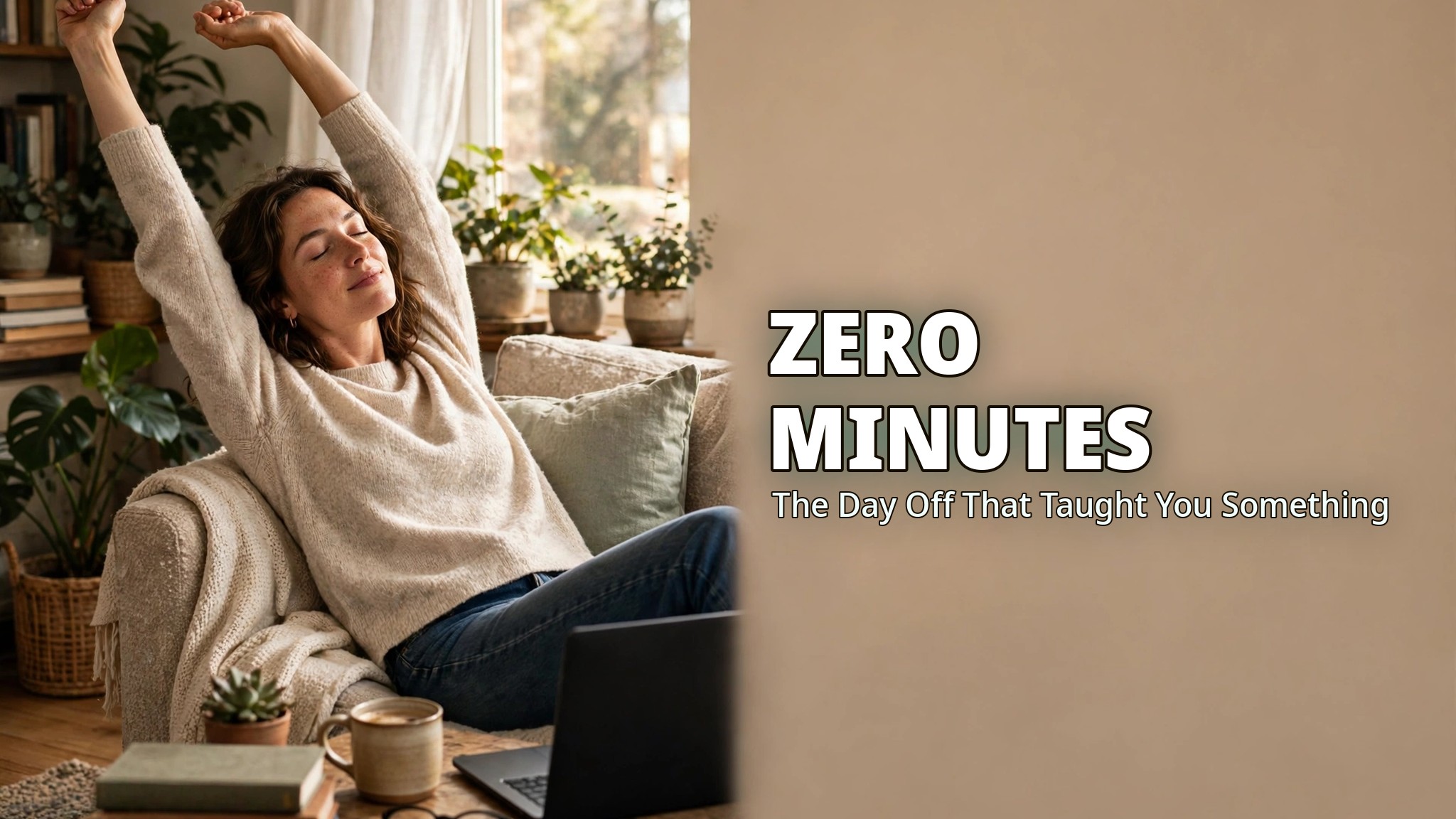
The closed laptop in the photo above is the whole method in one image. You do not uninstall anything, you do not delete your account, and you do not make a speech about quitting. You close the lid, you make coffee, and you let the day be about something else. If the urge comes back at noon, you write it down instead of acting on it. The notebook holds the idea until tomorrow, and tomorrow the idea is usually still there, a little calmer than it felt at noon.
3. What the Day Gives Back
The first thing a zero-minute day gives back is attention. When you are not spending spare minutes on renders, those minutes go somewhere, and where they go is informative. Some people find they read more, some find they sleep better, and some find they are bored for the first time in months. Boredom is not a failure of the test. Boredom is the test working, because boredom is where new ideas actually come from.
The second thing it gives back is taste. When you stop producing for a day, you stop judging your own output, and your eye resets. The next morning, the images you were proud of yesterday look slightly different. Some look better than you remembered, because you were too close to them. Some look worse, because the habit of finishing had been doing the judging instead of you.
The third thing is a list. Every urge you write down during the day is a prompt idea that survived a whole day without being generated. Prompts that survive a day of waiting are usually the ones worth spending credits on, because they were not born from a spare minute and a restless thumb. They were born from an idea that kept knocking.
4. The Urge to Peek
Almost everyone peeks, or wants to. The urge usually arrives disguised as a practical reason: you need to check whether yesterday’s render finished, or you want to save one file, or you just want to look at the gallery for inspiration. None of those reasons is a lie. All of them are the habit wearing a practical costume, and the costume is convincing because the reasons are real.
The honest way to handle the urge is to write it down with a time stamp. “10:42, wanted to check the render.” Then keep going with the day. At the end of the day, read the list. Most people find the same urge repeated three or four times, and that repetition is the discovery: it was never one practical need, but one habit knocking on the same door all day.
If you do peek, the day is not ruined. Note it, close the tab, and continue. A test with one peek still tells you almost everything a perfect day would tell you, because the interesting data is the urge itself, not your perfect resistance to it. The only way to fail the test is to pretend the urge never happened and learn nothing from it.
5. What You Notice Without a Screen
Without a screen in front of you, the world gets louder in small ways. Light in the morning looks different when you are not racing it to a render. A walk takes longer, because you are not thinking about the next prompt while you walk. Conversations last longer, because you are not half-listening while a generation runs in another tab. None of this is profound. All of it is the point.

The walk in the photo is the simplest version of this. No destination, no podcast about productivity, no phone in hand. Just a path, some trees, and an hour that belongs to nobody. If that sounds unproductive, notice how many of your best prompt ideas arrived on walks, in showers, or in the ten minutes before sleep. Ideas do not arrive while you are generating. They arrive while you are doing something else, and a zero-minute day is a day built entirely out of something else.
Creators who generate every day often forget that their taste is fed by the world, not by the tool. The tool can only remix what you have already seen. A day outside, looking at real light, real rooms, and real people, feeds the part of your taste that the generator cannot reach. You come back with better references in your head, and better references make better prompts.
6. What It Costs
A zero-minute day costs nothing, which is exactly why it is worth doing. No credits leave your balance, no pack is touched, and no subscription question comes up. For comparison, a single text-to-image generation takes 49 créditos, about $0.12 on the $19.99 pack, which buys 1,000 créditos. A video template costs 351 credits for five seconds, about $7.02 on the same pack, or 561 créditos, about $11.22, for eight seconds. Prices checked 13 Nov 2026.
The real cost of a day off is not money. It is the output you did not make, and that cost is smaller than it feels. One day without new images does not shrink your gallery, does not lose your audience, and does not make you forget how to prompt. The fear that it will is the habit talking, and the habit is exactly what the day is for.
There is also a hidden saving. A day off breaks the chain of small, restless generations that add up quietly: the third retry of a prompt that was fine, the test render you did not need, the image you made because the tab was open. Those are the credits that disappear without a keeper to show for them. One day of not generating often saves more than the price of one image, because it resets the reflex that was spending them.
7. Honest Limitations
A day off does not fix a broken workflow. If your prompts are weak, your references are wrong, or your settings are off, a day of rest will not repair any of that. It will only show you the problem more clearly when you return. Rest is a diagnostic, not a cure.
A day off also does not suit every week. If you have a deadline, a launch, or a client waiting, skipping a day is not discipline, it is avoidance. The test is for ordinary weeks, when the generating is habitual rather than necessary. If the day off feels like an excuse to dodge real work, it probably is, and the honest move is to do the work and take the day off another week.
Finally, one day is a small sample. It tells you what one day feels like, not what a week would feel like, and not what your habit looks like over a month. Treat the result as a hint, not a verdict. If the day felt good, try one day a week for a month and see whether the feeling holds. If it felt bad, try a half day instead, and see what the smaller dose teaches you.
8. Who This Is For
This guide is for the daily generator: the person who opens the tool every morning without deciding to, who has a gallery full of images they cannot remember making, and who feels a small itch on any day they do not generate. If that description stings a little, the day off is probably for you, because the sting is the habit noticing itself.
It is also for the person who suspects their best ideas are getting drowned. When you generate every day, the new images bury the old ones before you have learned from them. A day off is a pause that lets the last week settle, so you can see which images actually held up and which ones were only exciting for an hour.
It is not for the person who generates once a week or less. If you already take days off without thinking about it, you have nothing to learn from a formal one. Your test is the opposite: a day of deliberate, focused generating, with a plan and a notebook, to find out what a full session can do when you actually show up for it.
9. Consent and Safety
A day off changes nothing about consent, and that is worth saying plainly. The rules do not take a day off with you. Every image you make when you return must still show only fictional adults, made with consent, and never a real person without their permission. A rested creator is not a careless creator, and the day off is not a licence to come back and cut corners.
The same goes for safety in the other direction. If you use the day off to look for new reference material, keep the same boundaries you keep while generating: fictional characters only, adults only, and nothing that involves a real person who did not agree to be used. A day away from the tool is a good time to clean up your reference folder, delete anything you are unsure about, and come back with a library you can defend.
Finally, keep the day off honest with yourself. If the urge to generate is really an urge to avoid something else, a day off will not fix that either. It will show it to you, clearly, for one whole day, and that clarity is the gift.
10. Final Verdict
Zero minutes is the cheapest test in this whole series, and one of the most useful. It costs nothing, it takes one day, and it tells you whether your daily generating is a practice or a reflex. If the day feels restful and your next session is sharper, make it a weekly habit. If the day feels empty and your ideas dry up, you have learned something just as valuable: your routine was feeding you more than you thought. Either way, you come back knowing something you did not know before, and that is what a day off is for. Try it once, write down what happened, and let the notes decide whether it happens again.
11. FAQ
What is a zero-minute day?
A full day when you do not open the generator at all: no renders, no gallery scrolling, no checking results. The day is spent on everything else.
Will I lose my skills if I take a day off?
No. One day without generating does not shrink your gallery or dull your prompting. Most people come back sharper, not duller.
What should I do when the urge to generate hits?
Write it down with a time stamp and keep going. At the end of the day, the list shows you how often the same urge repeated.
How much does a zero-minute day cost?
Nothing in credits. For comparison, one text-to-image generation takes 49 créditos, about $0.12 on the $19.99 pack. Prices checked 13 Nov 2026.
What if I peek and open the generator?
Note it, close the tab, and continue. One peek does not ruin the test; the urge itself is the interesting data.
How often should I take a zero-minute day?
Start with one day, once. If it felt good, try one day a week for a month and see whether the feeling holds.
Keep reading:
- The Five-Minute Workflow: What You Can Actually Finish in Five Minutes (2026)
- Your Workflow, Timed: Where the Minutes Really Go in a 30-Minute Session (2026)
- Teach It to Learn It: What Explaining Your Workflow to a Beginner Reveals (2026)
Plan your return session on the Generador de porno IA page, turn a keeper into motion on the Generador de videos porno IA page, fix the almost-right image on the Editor de Imágenes IA page, and find your keepers again in the Galería.