From Idea to Finished AI Porn in 30 Minutes: A Timed Workflow (2026)
Thirty minutes, one finished piece. Not a perfect piece, not a portfolio piece — a finished piece. The difference between a creator who ships and a creator who tweaks is not talent. It is a clock. Thirty minutes, a timer, and a rule: when the clock says stop, stop. The workflow in this guide is thirty minutes long, minute by minute, and it ends with a finished image in your collection — not a tenth draft in your downloads folder.
This guide is about a 30-minute idea-to-finished workflow for AI porn: the timed steps, the timer rule, and the five ways the thirty minutes breaks. It is written for fictional adult content only. The consent rule is absolute: generate images and videos of yourself, or of fictional adults, and never of a real person without their consent.
Quick verdict
Five minutes to write the prompt, ten minutes to generate three images, five minutes to pick one, five minutes to fix it, five minutes to export and file it. Generate three, not ten. Pick one, kill the rest. When the clock says stop, stop.
In this guide
- 1. Thirty minutes, one finished piece
- 2. Minutes 0–5: the idea and the prompt
- 3. Minutes 5–15: generate three, not ten
- 4. Minutes 15–20: pick one, kill the rest
- 5. Minutes 20–25: fix the face, fix the hands
- 6. Minutes 25–30: export and file it
- 7. The timer rule: when the clock says stop, stop
- 8. Five ways the thirty minutes breaks
- 9. Cost: what thirty minutes costs
- 10. Consent: the rule that decides everything
- FAQ
The thirty-minute clock
| Minutes | Step | Done when | Do not |
|---|---|---|---|
| 0–5 | Idea and prompt | One sentence, one prompt | Do not browse for ideas |
| 5–15 | Generate three | Three images, same prompt | Do not generate ten |
| 15–20 | Pick one | One winner, two deleted | Do not keep all three |
| 20–25 | Fix it | Face and hands fixed | Do not rebuild it |
| 25–30 | Export and file | Named, filed, done | Do not start the next one |
The table is the whole guide in one place. Five steps, five minutes each, and the clock is the boss. The rest of this guide is each step in detail: what to do, what done looks like, and what not to do.
1. Thirty minutes, one finished piece
Thirty minutes, one finished piece, because a finished piece is a piece you can use, and a draft is a piece you cannot. A creator who finishes one piece a day has 30 pieces a month. A creator who tweaks one piece a day has zero. The workflow is the difference, and the workflow is the clock.
And thirty minutes is enough: five minutes to think, ten to generate, five to pick, five to fix, five to file. Enough is the point — a workflow that needs two hours is a workflow you will not do. A workflow that needs thirty minutes is a workflow you will do every day.
And the rule is the clock: start the timer, and the timer is the boss. The timer does not care about perfection. The timer cares about done. Done is the goal, and done is the piece.
2. Minutes 0–5: the idea and the prompt
The idea and the prompt, because five minutes is enough to decide, and five minutes is too short to doubt. Write one sentence: the subject, the style, the scene. “A woman in a red dress, in a library, warm light.” One sentence, one prompt, and the prompt is the idea. A prompt longer than one sentence is a prompt you have not decided.
And do not browse for ideas: browsing is not deciding, and browsing is how five minutes becomes fifty. The idea is yours, and yours is enough. Write it, and move on. The clock is the boss, and the boss says five minutes.
And write the prompt down, not in your head: a prompt in your head is a prompt you will change, and a prompt you change is a prompt you never generate. Write it, and the writing is the decision.
3. Minutes 5–15: generate three, not ten
Generate three, not ten, because three is a choice and ten is a chore. Three images from the same prompt, same settings, different seeds — and the three are the choice. Ten images is ten choices, and ten choices is no choice. Three is the number, and three is the rule.
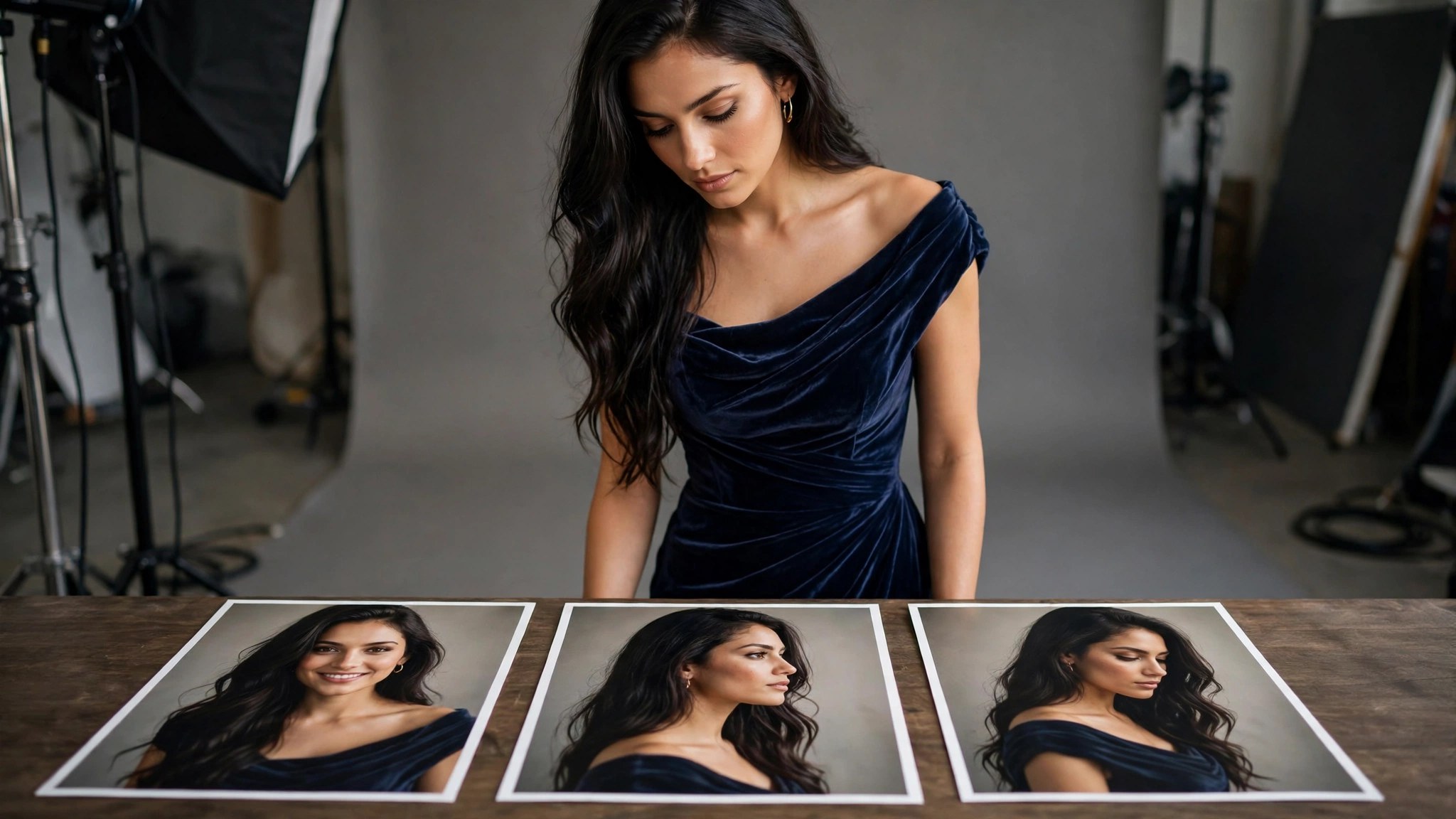
And do not change the prompt between the three: the same prompt, three seeds, and the difference is the seed, not the prompt. A changed prompt is a new idea, and a new idea is a new five minutes. Same prompt, three seeds, and the three are the test.
And while the three generate, do nothing: no browsing, no tweaking, no second idea. Ten minutes is the generation, and the generation is the waiting. Waiting is the work, and the work is the clock.
4. Minutes 15–20: pick one, kill the rest
Pick one, kill the rest, because a finished piece is one piece, and three pieces is three drafts. Look at the three, pick the best, and delete the other two. Deleting is the decision, and the decision is the workflow. A creator who keeps all three is a creator with three drafts, and three drafts is zero finished pieces.
And pick fast: five minutes, one look, one pick. The best is usually obvious in ten seconds, and ten seconds is the pick. A pick that takes five minutes is a pick between equals, and equals are a coin flip. Flip the coin, pick one, and move on.
And do not pick the “almost” one: the almost one is the one you will fix for an hour, and an hour is not in the clock. Pick the best one, and the best one is the one that needs the least fixing.
5. Minutes 20–25: fix the face, fix the hands
Fix the face, fix the hands, because the face and the hands are the two things that break first, and the two things the viewer sees first. A face that is off is a photo that is off. Hands that are wrong are hands that are wrong. Fix those two, and the photo is done.

And fix once, not twice: one pass on the face, one pass on the hands, and the fixing is done. A second pass is a rebuild, and a rebuild is a new thirty minutes. One pass, five minutes, and the photo is fixed.
And do not rebuild it: a rebuild is a new idea, and a new idea is a new thirty minutes. Fix the face, fix the hands, and stop. Stopping is the skill, and the skill is the clock.
6. Minutes 25–30: export and file it
Export and file it, because a finished piece in your downloads folder is a lost piece, and a lost piece is a piece you never use. Export it, name it, and file it: a name that says what it is, a folder that says where it goes, and the piece is done. A piece without a name is a piece you will never find.
And name it now, not later: later is never, and never is a folder full of “untitled-47”. A name is five seconds, and five seconds is the filing. Name it, file it, and the thirty minutes is done.
And do not start the next one: the next one is the next thirty minutes, and the next thirty minutes starts after a break. A break is the reward, and the reward is the workflow. Done is the goal, and done is the piece.
7. The timer rule: when the clock says stop, stop
When the clock says stop, stop, because the clock is the boss, and the boss does not negotiate. Five minutes over is five minutes stolen from the next piece, and five minutes stolen is a workflow that slips. The timer is the rule, and the rule is the workflow.
And if a step is not done when the clock says stop, the step is done anyway: a prompt that is good enough is good enough, and a fix that is good enough is good enough. Good enough is the standard, and the standard is done. Perfect is the enemy, and the enemy is the clock.
And if the thirty minutes feels too short, the workflow is working: a workflow that feels too short is a workflow that pushes you, and a workflow that pushes you is a workflow that ships. Too short is the point, and the point is the piece.
8. Five ways the thirty minutes breaks
- Browsing for ideas. Five minutes becomes fifty. Fix: write the idea before you start the timer.
- Generating ten. Three is a choice, ten is a chore. Fix: generate three, same prompt, different seeds.
- Keeping all three. Three drafts is zero finished pieces. Fix: pick one, delete the other two.
- Rebuilding the fix. A rebuild is a new thirty minutes. Fix: one pass on the face, one pass on the hands, then stop.
- Starting the next one. No break is no reward. Fix: export, file, and take five minutes off.
Fix one break at a time. One break, one fix, and the workflow holds. The workflows people remember were not born right. They were beginners who fixed one break, and the fix held.
9. Cost: what thirty minutes costs
Three images at 49 credits is 147 credits — roughly $2.94 on the $19.99 pack and $1.76 on the $59.99 pack. One five-second video at 720p is 351 credits — roughly $7.02 on the $19.99 pack and $4.21 on the $59.99 pack. One undress is 21 credits — roughly $0.42 on the $19.99 pack and $0.25 on the $59.99 pack. Prices checked 12 Nov 2026; the generator shows the exact cost before you run it, so the price is never a surprise.
And that is why generating three, not ten, is a money rule: three images cost 147 crédits, and ten images cost 490. The seven extra images are 343 credits of chore, and chore is not a choice. Three is the saving, and the saving is the clock.
The paid packs are for generation: $19.99 for 1000 crédits, $59.99 for 5000 crédits, and the annual packs at $119.88 and $359.88, paid once and delivered monthly over twelve months.
10. Consent: the rule that decides everything
Only generate images and videos of yourself, or of fictional adults. Never generate an image or a video of a real person without their consent — not a celebrity, not an acquaintance, not a stranger. Non-consensual generation is not allowed, and a generated image is harder to take back than a photo once shared. The tool is built for your own images and fictional adults, and that boundary is absolute.
This is also practical, not just ethical: images made with consent are usually better inputs and better results. They are shot properly, well lit, front-facing — because the person knew they were being photographed. A stolen or secret photo is usually dark, cropped, or shot from a bad angle, which is also a bad input. Consent and quality point the same way — and a thirty-minute workflow, built on a consented image, is the proof: it works because the input is clean, not because the clock is fast.
FAQ
Can I really finish an AI porn image in 30 minutes?
Yes. Five minutes to write the prompt, ten to generate three images, five to pick one, five to fix the face and hands, five to export and file it. Thirty minutes, one finished piece.
Why generate three images, not ten?
Because three is a choice and ten is a chore. Three images from the same prompt, different seeds, and the three are the choice. Ten images is ten choices, and ten choices is no choice.
What if the image is not done when the timer ends?
Then it is done anyway. A prompt that is good enough is good enough, and a fix that is good enough is good enough. Perfect is the enemy, and the enemy is the clock.
How do I pick the best of three?
Fast: one look, ten seconds, one pick. The best is usually obvious in ten seconds. Pick the one that needs the least fixing, and delete the other two.
How much does a 30-minute workflow cost?
Three images at 49 credits is 147 credits — roughly $2.94 on the $19.99 pack and $1.76 on the $59.99 pack. Ten images would cost 490 crédits, and the seven extra are chore, not choice.
Can I make AI porn of a real person?
No. Only generate images of yourself, or of fictional adults. Generating an image of a real person without consent is not allowed.
Final verdict
Five minutes to write the prompt, ten minutes to generate three images, five minutes to pick one, five minutes to fix it, five minutes to export and file it. Generate three, not ten. Pick one, kill the rest. When the clock says stop, stop.